|
|
 |
|
**List: Slavonic Ministry the Bible ( the Bible )
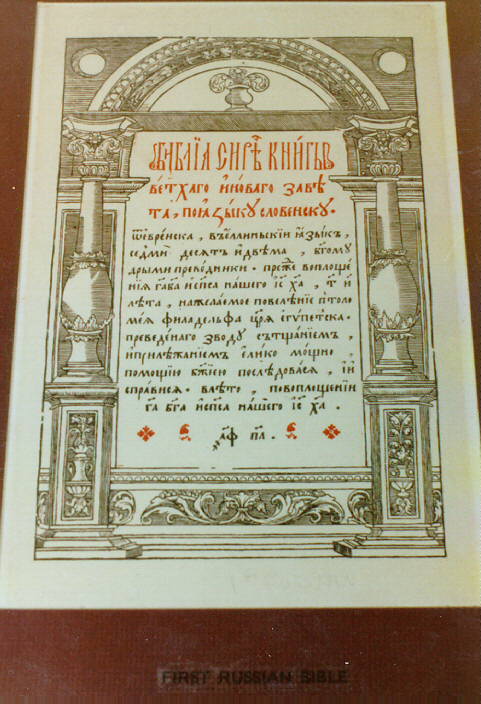
SCLAVONIAN VERSION (SCLAVONIC), from the Edition printed at St Petersburgh--1860 S. Bagster [Info only: col. #1 Slavonic Character "1822" John 1:1-12 unknown. col. 2 Russian.] |
Slavonic Bible History (3)
**List: Slavonic Ministry
the Bible ( the Bible )
Slavonic...
SCLAVONIC. "I.--GEOGRAPHICAL LOCATION. THE Sclavonic nations, generally supposed to be descended from the ancient Sarmatæ or Sauromatæ,
are frequently mentioned by the Byzantine historians under the various appellations of Slavi, Antæ,
Vandales, Veneti, and Vendes. They now occupy more than one-third of Europe, and number
upwards of 60,000,000 individuals. Various dialects prevail among this great family of tribes, but the
liturgic or old church dialect, in which the ancient Sclavonic version of the Scriptures and the Liturgy
of the Russian Church are written, is now extinct: it is elevated to the rank of a sacred language, and
in Russia is employed exclusively for ecclesiastical purposes, and in public worship. It is impossible,
at this distance of time, to ascertain with any degree of precision by what tribe or tribes this ancient
dialect was spoken, or in what region it was vernacular; but as Cyril and Methodius, the great apostles
of the Sclavonians, laboured among the Servians, Moravians, and Carniolans, there can be little doubt
that the version prepared by them for the edification of these tribes was written in the idiom then most
generally understood among them.II.--CHARACTERISTICS OF THE LANGUAGE. [...]
III.--ALPHABETICAL SYSTEM. [...]
IV.--VERSIONS OF THE SCRIPTURES IN THIS LANGUAGE. The Sclavonic version is a faithful and literal representation of the original Greek text. It was
chiefly executed during the ninth century by Cyril and Methodius, the first mies. to the
Sclavonians. The name of the former was properly Constantine, but he assumed the name of Cyril
(by which he is more generally known) about forty days before his death. He and his brother
Methodius were the sons of Leo, a Greek nobleman of Thessalonica. Cyril, though the younger of the
two, was the most noted for his profound knowledge of Scripture and of the writings of the Greek
fathers: in his youth he enjoyed the best education as companion to the young Prince Michael, but,
undazzled by the prospect of worldly distinction, he withdrew from court, and in a monastery near the
shores of the Black Sea prepared himself for the active duties of his laborious career. Methodius
originally held an appointment in the army, and afterwards, for the space of ten years, was governor
on the Sclavonian frontiers, where he had ample opportunity for the study of the Sclavonian dialects.
He also retired from public life, and secluded himself for a time in a monastery on Mount Olympus.
He then joined his brother in a mission to the Khazars, a Hunnic-Tartaric tribe; and at a subsequent
period he accompanied him to Moravia, where they spent four years and a half in translating the
Scriptures and instructing the inhabitant in the truths of Christianity. Their next journey was to
Rome, where Cyril died. Methodius returned to Moravia, to prosecute the great work which they had
jointly commenced; he died in 880.
The Sclavonic version is commonly said to have been the joint production of these mies.,but it is uncertain whether all the books of Scripture were translated by them. Nestor, in his Annals,
states that "they translated the Apostles (i. e. the Epistles) and the Gospels; and then they also trans-
lated the Psalter, the Octateuch, and the other books." It seems most probable that they completed a
version of the New Testament and of the Psalms, and that the remaining portions of the sacred volume
were added by other hands. It would be difficult, by any other hypothesis, to account for the extreme
scarcity and the recent date of MS. copies of the entire Sclavonic Bible; only three such copies are
now known to be in existence, and of these, the most ancient bears the date of 1499: whereas codices
of the New Testament, belonging to the eleventh, twelfth, thirteenth, and fourteenth centuries, are
frequently to be met with in Russia and other countries. The book of Proverbs is believed to have
been translated before, or in, the twelfth century, as the quotations made from it by Nestor agree, on
the whole, with the common text. The Prophetical Books and Job were translated, probably in Servia,
in the thirteenth or fourteenth century; and the Pentateuch and other books seem to have been trans-
lated in the fifteenth century, either in Russia or in Poland. At this latter period the several parts of
the Sclavonic Scriptures were for the first time collected into one volume, and arranged in order like
those of the Bohemian version which appeared in 1488.
The first portion of the Sclavonic version committed to the press was the Psalter, an edition of
which appeared in 1491 at Cracow in Poland: a reprint of this book was published in Montenegro,
1495. The first edition of any part of the New Testament consisted of the Four Gospels, printed at
Ugrovallachia, 1512. Another edition of the Gospels appeared at Belgrade, 1552, and a third edition
in Montenegro, 1562.
In 1553, the Czar Ivan Vasilievitch caused a revision of the Sclavonic text to be undertaken, with
a view of rectifying the errors which had crept into it through the ignorance or carelessness of tran-
scribers. A printing office was established at Moscow by the czar for the purpose; the direction of the
work was confided to Hans Bogbinder, a native of Denmark, and the printing was committed to Ivan
Fedoroff, deacon of the Hostun Cathedral, and Peter Timofeeff; but owing to a variety of obstacles the
printing did not actually commence till ten years afterwards, and in 1564 appeared the first fruits of the
typographical art in Russia, consisting of the Acts, the Catholic and the Pauline Epistles, taken, no
doubt, from the best MSS. that could be then obtained in Moscow. Although executed under the
immediate patronage of the czar, much hostility was excited by the appearance of this work; the printers
were accused of heresy and magic, and were compelled to flee the country. Fedoroff took refuge in
Leopolstadt, where he republished the Acts and Epistles in 1573, and Timofeeff settled in Wilna,
where he printed an edition of the Sclavonic Gospels in 1575.
In 1577, an edition of the Psalms issued from the Moscow press; and about the same period
Constantine, Duke of Ostrog, formed the noble design of publishing an edition of the entire Scriptures
at his own expense, as the most effectual means of silencing the controversies then in agitation between
the Greek and Roman Churches. In order to secure the accuracy of the text, the duke made an
extensive collection of Sclavonic MSS. He also caused the Sclavonic text to be collated with that of
versions in other languages; but so many discrepancies were brought to light by this collation, that
those who were hostile to the undertaking endeavoured to persuade the benevolent projector to
abandon his design. So far, however, from yielding to despondency, he was only stimulated by these
difficulties to greater perseverance, "in the certain hope that, by the divine blessing on his efforts,
he should be enabled eventually to surmount them all." He therefore wrote to Italy, Greece, Servia,
Bulgaria, and Constantinople, requesting that individuals skilled in the Greek and Sclavonic tongues
might be sent to him, bringing with them the best-accredited copies of the sacred text. In compliance
with this request, many learned men resorted to Ostrog; and after the necessary collations and
corrections had been effected, the first edition of the Sclavonic New Testament was printed in 1580,
accompanied with the Psalms. It was printed by Fedoroff, the deacon originally employed by the
czar at Moscow.
In 1581, the first edition of the Sclavonic Bible left the Ostrog press. The editors did not
merely adopt the text of the Moscow edition, but consulted the Greek MSS. which had been brought
for the purpose from Greece; and it is probable that the text of this edition was also compared with
other versions.
The peculiar characteristics of the Sclavonic version may be concisely enumerated as follows, in
the words of Dobrovsky:--1. The Sclavonic version is very literally translated from the Greek, the
Greek construction being frequently retained where it is contrary to the genius of the Sclavonian; and
it resembles in general the most ancient MSS. 2. In the Gospels it agrees with the Codex Stephani η
(L. at Paris), more frequently than with any other Greek MS. 3. In the Catholic Epistles it agrees
in general with the Codex Alexandrinus, and frequently in the Revelation. 4. In the Acts, and in the
Epistles of St. Paul, it agrees in general with the most ancient MSS.; but sometimes with one, some-
times with another, yet most frequently with Wetstein’s Codex E. (Codex Laudianus at Oxford). 5. Of
the readings adopted by Griesbach in the text of his Greek Testament, the Sclavonian version has at
least three-fourths. 6. Where the united evidence of ancient MSS. is against the common printed
reading, the Sclavonic version agrees with the ancient MSS. 7. It has not been altered from the
Vulgate, as some have supposed, though the fact is in itself almost incredible. 8. It varies from the
text of Theophylact in as many instances as they agree; and their coincidence is to be ascribed, not to
an alteration from Theophylact, but to the circumstance that both Theophylact and the author of the
Sclavonic version used the same edition of the original Greek. 9. The Sclavonic version has but few
readings peculiar to itself, or what the critics call "lectiones singulares." The controverted passage,
1 John 5:7, is not found in any MS. of the Sclavonic version, and was therefore omitted in the Ostrog
edition. In the second edition of the Bible, published 1633, it obtained a place in the margin, where
it was probably inserted on the authority of the Textus Receptus. In all modern editions, however, it
is admitted into the text.
Between the years 1581 and 1633 (the dates of the first and second editions of the Sclavonic
Bible), seven editions of the entire New Testament, besides several reprints of the Gospels and Epistles,
were published at Evie, near Wilna, at Wilna itself, at Kief, and other places. All these editions are
of extreme rarity.
The edition of the Bible of 1633 appeared at Moscow; it was projected by the Patriarch Nicon:
but that learned man took no part in its emendation. It was professedly corrected with care, but only
a few of the typographical faults of the former edition were removed; and such alterations as were
introduced were trifling, and of little moment.
In consequence of the numerous errors by which these two editions of the Sclavonic Bible were
disfigured, a new translation was undertaken at the command of the czar, by Epiphanius Slavinetzky,
a learned monk: he was appointed to prepare the work, in concert with other monks, under the eye
of the metropolitan, and a solitary but agreeable retreat near Moscow was assigned to the company of
translators. A rough copy of a version of the New Testament was just completed, when the death of
the metropolitan arrested the progress of the work, and the design was completely relinquished.
No farther steps were taken in the revision or printing of the Sclavonic Bible till the reign of
Peter the Great. In the year 1712, that monarch issued an ukase, ordering the printed Sclavonic text
to be carefully compared with the Greek of the Septuagint, and rendered in every respect conformable
to it. Certain learned monks were appointed to execute this work, and were directed, on all doubtful
points, to abide by the decision of Jaborsky, a dignitary of great eloquence and erudition, who after-
wards rose to be president of the Holy Synod. While this work was in progress, Peter the Great
caused an edition of the Sclavonic New Testament to be printed in parallel columns with the Dutch
version, with the view, no doubt, of familiarising his subjects with the language of Holland, and of
thus creating a closer connection between the two countries. This edition is now very scarce; a great
discrepancy is observable in the space taken up by the two columns, the Dutch language not admitting
of that conciseness with which the Sclavonic has imitated the original. A corresponding edition of
the Old Testament, in parallel columns with the Dutch, was also projected by Peter; but it was neverprinted, on account of the numerous discrepancies between the two versions, the one having been
executed from the Hebrew, and the other from the Greek. An additional obstacle to this edition
arose from the difference in the order of the books, and from the rejection of the Apocrypha by the
Dutch.
The revision of the Sclavonic version occupied nearly twelve years, and was not completed till
the year 1723. In the beginning of the following year, Peter the Great ordered the revised copy to
be put to the press; but his death during the course of that year greatly retarded the progress of
publication. Other obstacles, and the opposition of some of the members of the synod, occasioned
still further delay, and it was not till 1751 that this revised edition was published, it was printed at
St. Petersburg in a ponderous folio form, containing, besides the text, long and elaborate prefaces,
with tables of contents, and other useful additions. This edition has served as the basis of all subsequent
ones. Between the year of its publication and the year 1816, when the first stereotype edition
printed by the Russian Bible Society left the press, not fewer than twenty-one impressions of the whole
Sclavonic Bible, besides numerous editions of the New Testament, were put into circulation. The
total number of Sclavonic Bibles and New Testaments issued by the Russian Bible Society, during the
ten years of its active existence, amounts to 205,546."--The Bible of Every Land. (1860, Second Edition) Samuel Bagster [Info only]SCLAVONIAN VERSION (SCLAVONIC), from the Edition printed at St Petersburgh--1860 S. Bagster [Info only: col. #1 Slavonic Character "1822" John 1:1-12 unknown. col. 2 Russian.]
[Christian Helps Ministry (USA)] [Christian Home Bible Course]