|
"III.--VERSIONS OF THE SCRIPTURES IN THIS DIALECT.
It has been conjectured that the Scriptures were translated
into Irish soon after the introduction
of Christianity into the island, but we possess no definite account of any
early version. The MS.
containing the life of Moses and the patriarchs, described by Vallancey,
although of unquestionable
antiquity, is rather an historical compendium than a direct translation from
the sacred text. There is no
positive evidence of the existence of the Scriptures in Erse till the age
immediately preceding that of
Wickliffe, when a version
of the New Testament is stated to have been in the possession of Richard
Fitzralph, a native of Dundalk, raised in 1347 to the see of Armagh, and
hence frequently called
Richard Armachanus. Fitzralph is generally supposed to have been
himself the translator of this
version; and in his autobiography he relates "how the Lord
taught him, and brought him out of the
profound subtleties of Aristotle's philosophy to the study of the Scriptures
of God." Although he
was remarkable for the boldness with which he opposed the corruptions of the Church of Rome, yet
he was compelled by the troubles of the times to conceal his New Testament.
He deposited the
precious volume inside one of the walls of his church, and wrote the
following note on the last leaf:--
"When this book is found, truth will be revealed to the
world, or Christ will shortly appear." About
170 years after his death, that is to say, about the year 1530, the church of
Armagh was repaired, and
the MS. was discovered. No vestige of it, however, exists at the
present time, although Fox in his
"Actes and Monumentes," published 1570, says,
"I credibly heare of certayne old Irish Bibles trans-
lated long since into the Irish tong, which if it be true, it is not other
lyke, but to be the doing of
this Armachanus:" and he adds that "this was
testified by certayne Englishmen, who are yet alyve,
and have seen it." Usher, also, speaks of fragments of an Irish
version being extant in his time.
In the year 1571 a printing press and a fount of Irish types
were provided by Queen Elizabeth
at her own expense, "in hope (as it is stated in the
dedication of the Irish New Testament) that God
in mercy would raise up some to translate the New Testament into their mother
tongue." The trans-
lation was soon afterwards undertaken by three distinguished individuals--
John Kearney, treasurer
of St. Patrick's, Dublin; Nicholas Walsh, chancellor of St. Patrick's, and
afterwards bishop of Ossory;
and Nehemiah Donellan, a native of Galway, who in 1595 became archbishop of
Tuam. Walsh was
murdered in his own house in 1585, while engaged in the prosecution of the
work. The translation
was not suspended after his decease, as his two fellow-labourers proceeded
diligently with it. Little,
however, is known concerning the result of their labours, except that they
prepared the way for the
completion of the version of the New Testament eventually published in 1602.
William Daniel, or
O’Donnell, archbishop of Tuam, by whom this version was completed and carried
through the press,
was assisted by Mortogh O’Cionga, or King, a native of Connaught. The
translation was made from
the Greek, "to
which," says Dr. Daniel in his epistle dedicatory to
King James, "I tied myself as of
duty I ought." The edition, printed in 1602, was in the Irish
character, and in folio, and consisted
of 500 copies; the expense was defrayed by the province of Connaught,
and by Sir William Usher,
clerk of the council.
With the exception of the passages of Scripture inserted in the
Book of Common Prayer, which
had been translated into Irish and printed by Dr. Daniel in 1608, no portion
of the Old Testament
existed in this language until the venerable Bishop Bedell
undertook to procure a translation.
Although appointed in 1629 to the see of Kilmore and Ardagh, he was an
Englishman by birth, and
unacquainted with the language of his new diocese. His first step
toward the accomplishment of his
important design was, therefore, the acquisition of the Erse dialect, which
he commenced to study at
the age of fifty-seven. His next measure was to secure the services of
a native Irish scholar, and with
the advice of Primate Usher, his choice fell on Mr. King, who had, as before
mentioned, been employed
by Dr. Daniel. He likewise availed himself of the assistance of the
Rev. Dennis O’Sheriden, and with
the aid of these two individuals, the version of the Old Testament was
completed in 1640. Mr. King
being ignorant of Hebrew, the translation was made in the first place from
the English version. To
Bishop Bedell the Hebrew and the Septuagint were as familiar as the English, for the
Scriptures had
for years been his favourite study. It was his custom, says his
biographer, every day after dinner and
supper to have a chapter of the Bible read at his table, whoever might be
present; when Bibles being
placed before each individual, the Hebrew or
Greek was laid before himself. As
he compared the
Irish translation with the English, so he compared both with the Hebrew,
the Septuagint, and with
the Italian version of his friend
Diodati, whom he highly valued. Every portion of the Irish Bible
was thus tested by direct comparison with the original text; and for this
task Bishop Bedell was
peculiarly qualified, having resided many years at Venice as chaplain to Sir
Henry Wotton, where he
had studied Hebrew under Rabbi Leo, the chief chachan of the Jewish
synagogue. For some cause
or other, however, Mr. King, then above eighty years of age, incurred the
enmity of Usher and some
other bishops, in fact of the very persons by whom he had
been recommended as a translator, and
great opposition was made to the translation; the old man
sank beneath these unjust persecutions, but
Bishop Bedell remained firm in his determination to publish the version, and
finally resolved to
print it at his own expense, and in his own house. But while he was
making preparations for the
undertaking, the rebellion broke out; his palace was attacked, and he
and his family were sent
prisoners to the Castle of Lochwater. He was soon afterwards removed
to the house of his friend
Dennis O’Sheriden, where he closed his career of usefulness in
1641.
After the death of this excellent prelate, the circulation of
the vernacular Scriptures was utterly
neglected by the bishops and clergy of Ireland; the version of the Old
Testament was suffered to
remain in MS.; no attempt was made to reprint the New Testament; and even
the types that had been
provided by Queen Elizabeth, after being handed about from one printer to
another, were bought up
by the Jesuits, and were
carried by them to Douay, to be used as the vehicle of disseminating their
own sentiments among the native Irish. At length, when the New
Testament was completely out of
print, another edition was conferred on Ireland by the
munificence of a private individual, the Hon.
Robert Boyle. A new fount
of Irish types was cast by order of Mr. Boyle in London, with which
a second edition of the New Testament, consisting of about 750 copies in
4to., was published in
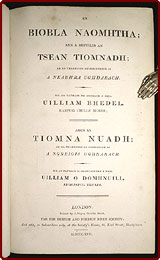
1681. This was followed by the printing of Bishop Bedell's version of
the Old Testament, chiefly
at the expense of Mr. Boyle. The MS. had been confided by Bedell to
the care of his friend Dennis
O’Sheriden, one of the translators, from whom it had passed to Dr. Henry
Jones, bishop of Meath:
this latter communicated with Mr. Boyle on the subject, and the MS. was
placed in the hands of
Dr. Andrew Sail for examination; the sheets were found in much
confusion, and defaced in some
parts. Dr. Sail, therefore, undertook to revise the
work, which revision he continued to prosecute till
his death in 1682. Mr. Higgins, the Irish lecturer in Trinity College,
who had assisted Dr. Sall in
preparing the corrected copy for the press, completed the revision in
conjunction with Mr. Reilly,
under the general superintendence of Dr. Marsh, afterwards primate of
Ireland. An edition con-
sisting of 500 copies of the entire Bible, in 2 vols. quarto, was printed in
London in 1686, under the
care of Mr. Reilly. Above 200 copies of this edition, as has already
been stated, were sent to
Scotland for the benefit of those to whom the
Gaelic tongue was vernacular.
More than a century was suffered to roll away before any
efficient measures were taken to reprint
the Scriptures in Irish. A second edition of the Bible was certainly
printed in 1790; but this edition
was in Roman characters, and designed chiefly for the Highlanders of
Scotland. In 1799, Dr. Stokes
published 2000 copies of St. Luke and the Acts, followed in 1806 by an
edition of the Four Gospels
and the Acts, in parallel columns of Erse and
English; but these small portions of
Scripture were far
from sufficient to meet the wants of the Irish nation, and were moreover
printed in the Roman
character. The honour of first supplying Ireland with Bibles, after so
long a period of destitution,
belongs to the British and Foreign Bible Society. "In 1809," says Mr. Owen, "after a
discussion,
alternately suspended and renewed, for five years, and a correspondence of
considerable extent with
prelates, scholars, and public bodies in Ireland, an edition of the New
Testament of 2000 copies, con-
formable to the accredited version of Bishop Bedell,
was put to press by the Society. This edition
was in Roman characters, and was followed in 1813 by another edition from the
same stereotype
plates, of 3000 copies. Another edition of 2500 copies was struck off
in 1816, and again another of
3000 copies in 1817. An edition of the complete
Irish Bible, in Roman characters, was issued by the
Society in 1817; the version of Bedell was employed as the text of the Old
Testament. The edition
was in octavo, and consisted of 5000 copies. In the course of the
following year, 3000 copies of the
New Testament, in the Irish character, were struck off from stereotype plates.
At length in 1828 the
entire Irish Bible appeared in the vernacular character, from the version of
Bedell and Daniel. The
edition was published under the superintendence of a committee, and consisted
of 5000 copies in 8vo.,
besides 20,000 copies of the New Testament. The editor on this
occasion was Mr. M‘Quige; but the
sheets were likewise examined by Dr. Monck Mason and others."
The Society for Promoting Christian
Knowledge have had their attention recently directed to the superintendence of
a revised edition of
the Irish Scriptures, but the work has been deferred until the more urgent
demand for a revised edition
of the Common Prayer Book (at present in progress) shall have been met.
The total number of Irish
Bibles and Testaments that have been published by the British and Foreign
Bible Society up to the
year 1860 is as follows:--
Bibles . . . . . . 15,000
Testaments . . . . . 84,523
Separate Books . . . . . 18,020
---------
Total . . 117,543"--1860 S. Bagster [Info
only]
|