 |
|
|
|
**List: Gaelic Ministry the Bible ( the Bible )
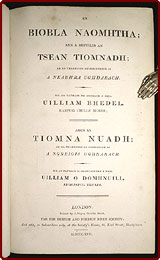
GAELIC.--1860 S. Bagster [Info only: n.d. John 1:1-14 unknown.] |
Gaelic Bible History (3)
**List: Gaelic Ministry
the Bible ( the Bible )
Gaelic...
"III.--VERSIONS OF THE SCRIPTURES IN THIS LANGUAGE. The venerable Bede informs us that, in his time, the Scriptures were read in Great Britain "in
five dialects then vulgarly used, viz. those of the Angles, Britons, Scots, Picts, and Latins." But if a
version of Scripture in the language we call Gaelic really existed in Bede's time, it is certain that nofragment of it is now extant; nor has any allusion to its existence been made by any other early writer.
Scotland, indeed, appears to have been left longer than almost any other part of Europe unprovided
with a version of the Bible in the vernacular language. In 1686, 200 copies of the Irish Bible,
printed, as is subsequently mentioned, at the expense of Mr. Boyle, were transmitted to Scotland for
the use of the Highlanders, and owing to the similarity between the two dialects, were found to be
generally intelligible. This edition was, however, printed in the Irish character, with which the
Highlanders were but imperfectly acquainted, whereas they had been taught to read, although they
could not understand, English. For their benefit, therefore, an edition of the Irish Bible was issued
in Roman characters in 1690: the work was printed in London under the superintendence of the
Rev. Robert Kirk, minister of Aberfoyle, and was promoted chiefly by the Rev. James Kirkwood,
of Astwick, and assisted by Mr. Boyle. Another small edition of the Irish New Testament (consisting
of about 500 copies) was published in Glasgow in 1754, but it was not till the year 1767 that a New
Testament in the Gaelic tongue was provided for the Scotch Highlanders. For this important trans-
lation, alike creditable to the venerable translator, and gratifying to all capable of understanding and appreciating it, Scotland was indebted to the Rev. James Stuart, of Killin: the work was published
at the expense of the Society in Scotland for Promoting Christian Knowledge, assisted by a grant from
the London Society. The first edition consisted of 10,000 copies in 12mo., and a larger edition of
21,500 copies was issued by the same Society in 1796.
Encouraged by the acceptableness of these editions, the next step of the Society was to obtain a
Gaelic version of the Old Testament. Several ministers co-operated in this translation, which was made
directly from the Hebrew text. To facilitate the work, the Old Testament was divided into four parts,
two of which were allotted to the Rev. Dr. John Stuart, minister of Luss, the son of the learned translator
of the New Testament. A third part, also, afterwards fell to his share, although it had in the first instance
been executed by another hand. The remaining fourth part, consisting of the Prophetical Books from
Isaiah to Malachi both inclusive, was translated by the Rev. Dr. Smith, of Campbeltown, and, on its
completion, was found to differ altogether in style and execution from the other portion of the Bible
translated by Dr. Stuart. The translation of Dr. Stuart was remarkable for its simplicity and its close
adherence, so far as the idiom of the Gaelic language would permit, to the letter of the sacred text;
whereas the Prophetical Books are translated in a style which is at once free and poetical, resembling
in some respects Bishop Lowth's translation of Isaiah. The work was published in parts: the first
part, containing the Pentateuch, appeared in 1783, and 5000 copies of the whole version were com-
pleted at press in 1801, at the expense of the Society. In consequence of many complaints concerning
the discrepancy in style between the prophetical and the other books, the Society resolved in their
next edition, to subject the former to a thorough revision, that they might be rendered conformable
to the other parts of the version. This plan was carried into effect in 1807, when an edition of 20,000
copies of the Old together with the New Testament was printed at Glasgow, under the care of the
Rev. Alexander Stewart, of Dingwall. Many opposed this version as fearing it would encourage the
existence of the Gaelic language (which some desired to extinguish, as identified with Jacobitism[?]).
Dr. Johnson did much to encourage the version. One of his letters shows the deep interest which he
took in the subject.
In the meantime, forcible representations having been made to the British and Foreign Bible
Society respecting the deplorable scarcity of copies of the Scriptures in the Highlands, and the
inadequacy of the means employed for their supply, the Society agreed to furnish an edition of the
Gaelic Bible, from the text adopted by the Scottish Society for the Promotion of Christian Knowledge.
This edition was published in London in 1807, nearly at the same time as the Edinburgh edition above
noticed: it consisted of 20,000 Bibles and 10,000 Testaments. It was received with the utmost joy
and gratitude by the Highlanders, but their demands for more copies still continued so urgent, that
the British and Foreign Bible Society, from time to time, have issued other editions; and the
total number of Gaelic Bibles and Testaments printed by them up to the year 1860, is 71,726Bibles, and 82,999 Testaments. The last boon conferred by this Society on the Highlands was a
Jubilee edition of 2000 copies of the entire Bible, with marginal references. The following list of
editions published by other societies is given by Mr. Anderson:--1810. By Scottish Society for the Promotion of Christian Knowledge 10,000 Bibles, 12mo.
1821. By ditto ditto ditto 10,000 Tests., 12mo.
1827. By ditto ditto ditto 1,000 Bibles, 4to.
1827. By ditto ditto ditto 2,000 Tests., 8vo.
1828. By Edinburgh Bible Society . . . . . . 7,500 Bibles, 24mo.
1828. By ditto . . . . . . . . . 5,000 Tests., 24mo.
1829. By ditto . . . . . . . . . . 10,000 Bibles, 12mo.
1829. By ditto . . . . . . . . . 5,000 Bibles, 8vo."--The Bible of Every Land. (1860, Second Edition) Samuel Bagster [Info only]GAELIC.--1860 S. Bagster [Info only: n.d. John 1:1-14 unknown.]
[Christian Helps Ministry (USA)] [Christian Home Bible Course]